How to See How Much a Shopify Store Sells (and How Accurate the Numbers Are)

The short answer
You can't see a Shopify store's exact sales; every number is an estimate. A quick range comes from monthly visits × conversion rate (about 1–3%) × average order value. New reviews per week and long-running ads are better signals than followers or total reviews, and tracking a store over time gives product-level sales and the trend.
"How much is this store making?" is the first question most people ask about a competitor. Shopify doesn't publish store revenue, and stores don't share it. But you can get surprisingly close by combining public signals, as long as you know which ones to trust and you think in ranges, not exact numbers.
This guide covers the methods that work, the ones that mislead, a worked example, and how accurate any estimate can really be.
Can you see a Shopify store's exact sales?
No. Shopify keeps each store's orders and revenue private, and there's no public page or setting that reveals them. Anyone claiming to show a store's exact revenue is estimating.
What you can do is estimate sales from signals the store shows publicly. Good estimates get you the right order of magnitude and, more usefully, the direction: is the store growing, flat or shrinking, and which products drive it?
Which public signals reveal a store's sales?
Not all signals are equal. Here's how they compare:
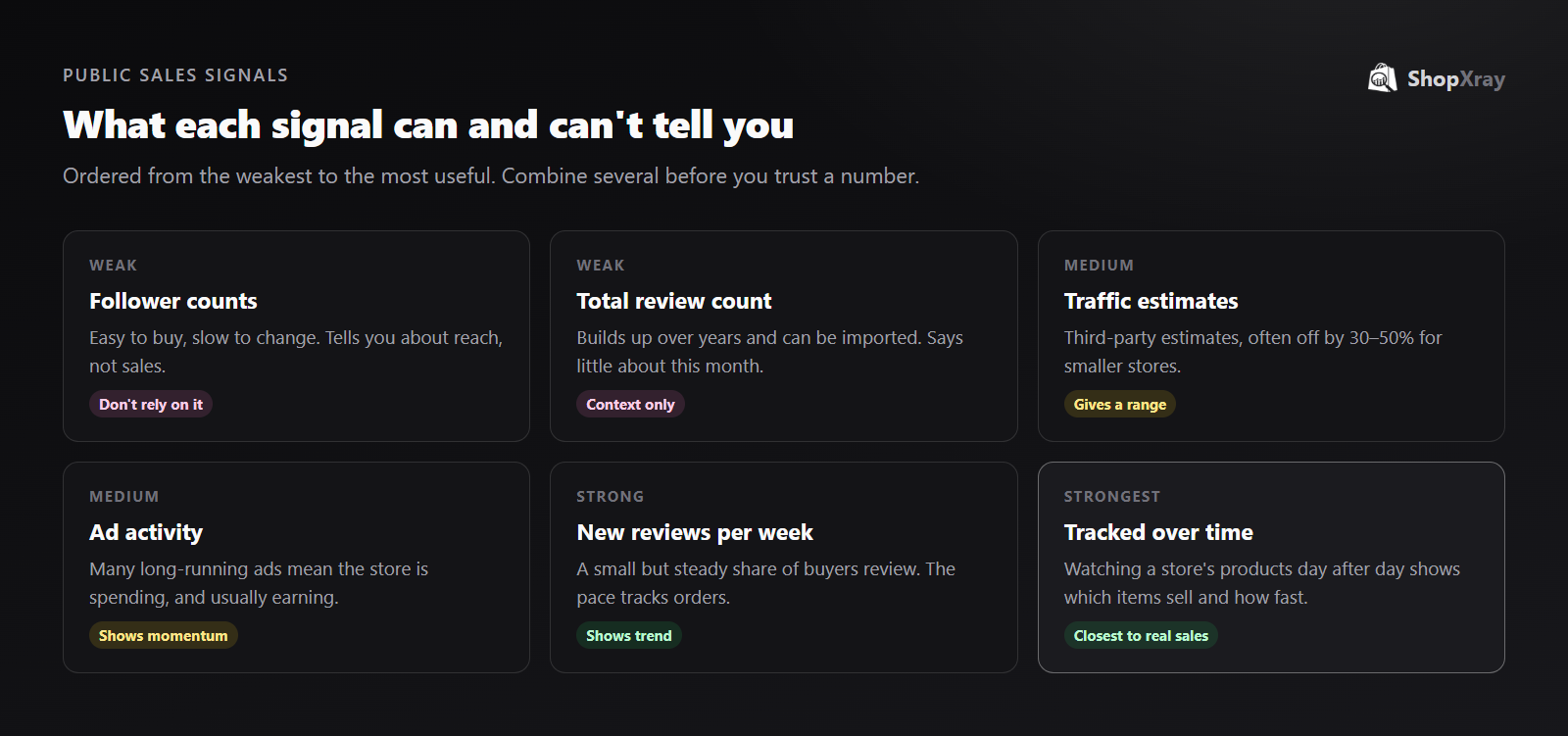
- Follower counts measure reach, not purchases, and can be bought. Ignore them for sales.
- Total review count builds up over years and can be imported from other platforms. Useful context, poor sales signal.
- Traffic estimates from tools like Similarweb or Semrush give a starting range. They're often far off for smaller stores.
- Ad activity in the Meta Ad Library shows whether a store is spending. Stores rarely keep spending on ads that don't sell.
- New reviews per week track orders better than the total. A small, fairly steady share of buyers leaves a review, so the pace of new reviews moves with sales.
- Watching the store over time comes closest. Following a store's products day after day shows which items are selling and how fast.
How do you estimate revenue from traffic?
The classic back-of-the-envelope method multiplies three numbers:
Monthly visits × conversion rate × average order value = monthly revenue
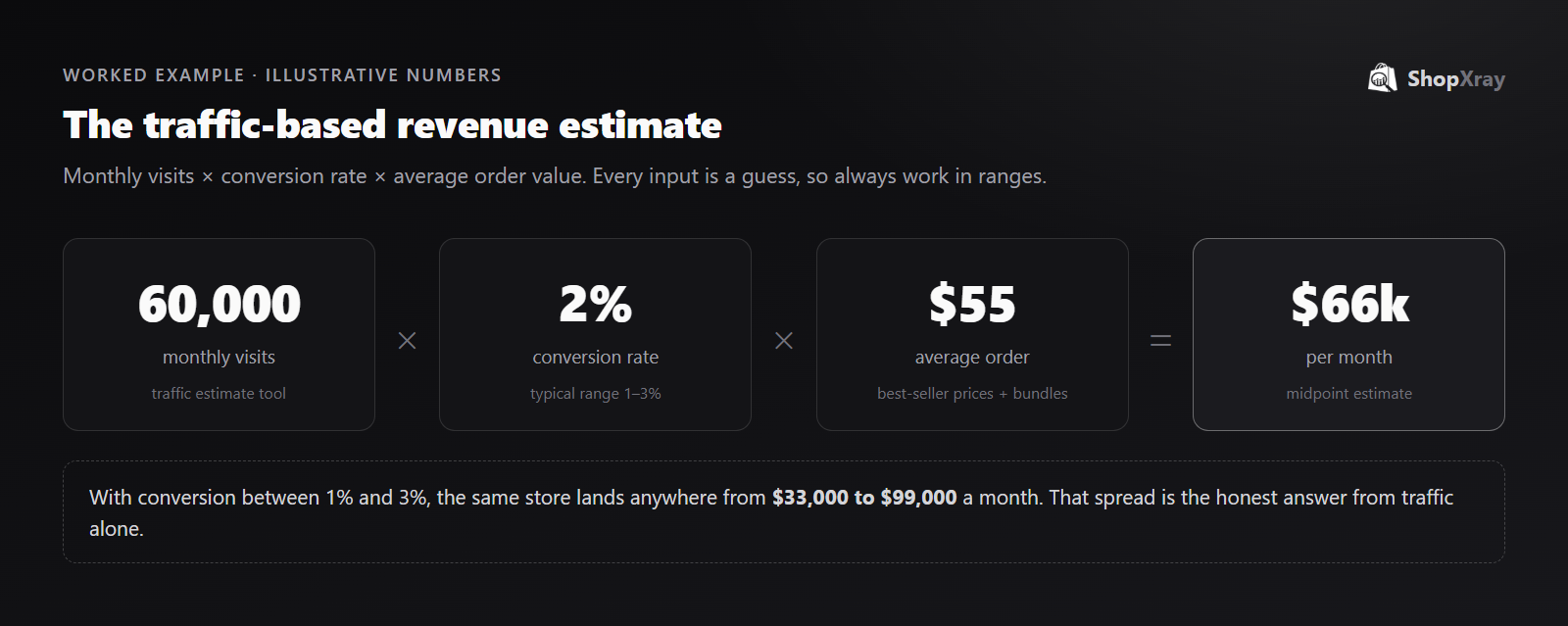
- Monthly visits. Take the estimate from a traffic tool. Treat it as a rough number, especially for stores with fewer than about 50,000 visits a month.
- Conversion rate. Most ecommerce stores convert somewhere around 1–3% of visits into orders. Strong brands with loyal customers sit higher; stores running cold traffic from ads sit lower.
- Average order value. Look at the prices of the store's best sellers, then adjust for bundles, free shipping thresholds and upsells that push baskets up.
In the example, a store with 60,000 visits, a 2% conversion rate and a $55 average order makes about $66,000 a month. But with conversion anywhere between 1% and 3%, the honest answer is $33,000 to $99,000. That's why this method is a starting point, not an answer.
How do sales tracking tools work?
Sales trackers watch a store's inventory over time. Every product variant on a Shopify store has a stock level, and when it drops between two scans, units were most likely sold. Multiply the units by the variant's price at that moment and you get estimated revenue per product and per day. Restocks (stock going up) are detected and kept out of the sales count. Because they follow each product continuously, they show which products sell, how many and when, which a traffic estimate can't.
ShopXray's Shopify sales tracker does this for any store you add: it scans the store's products every 12–24 hours, estimates daily sales and revenue by product and keeps a history, so you can see trends, launches and the effect of promotions.
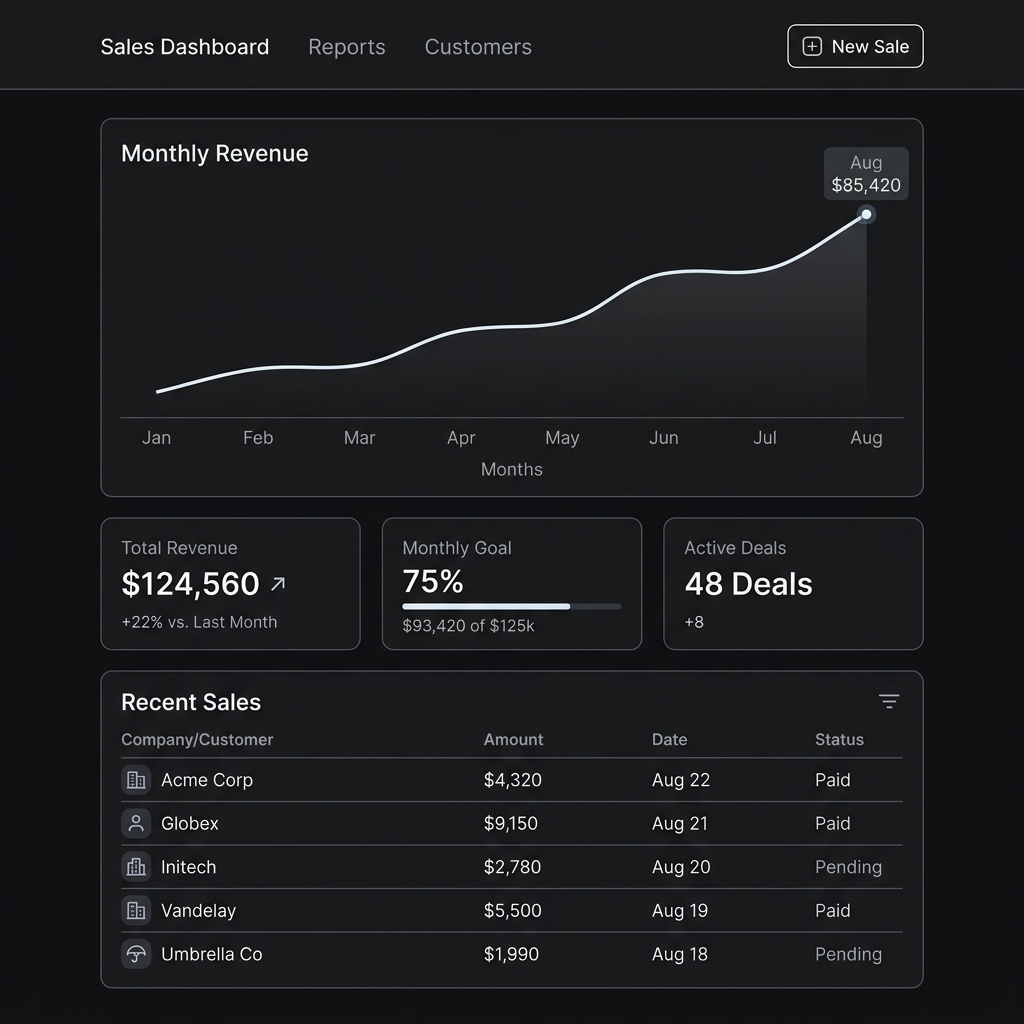
For a quick, one-off estimate without tracking, the Shopify revenue checker gives a starting range.
How accurate are Shopify sales estimates?
More accurate for some stores than others. Every method, ours included, estimates from public data, so it helps to know what throws estimates off:
| Factor | Effect on estimates |
|---|---|
| Products without tracked inventory | No stock level to watch, so those products show no sales |
| Manual stock edits | A merchant correcting stock by hand can look like a sale or a restock |
| Sales on other channels (Amazon, retail, wholesale) | Storefront signals miss them, so total revenue is understated |
| Subscriptions | Recurring orders may not show up the way one-off purchases do |
| Bundles and kits | Can be counted as one item or several, depending on how the store sets them up |
| Very large catalogs | More products means more noise in any estimate |
| Heavy discounting | Revenue per order drops, so unit estimates overstate revenue if prices aren't tracked |
| Stores that hide data | Some stores deliberately make their storefront harder to read |
What can you do with a competitor's sales estimate?
- Size the market. Add up estimates for the top stores in a niche to see whether it can support another brand.
- Find the products that carry a store. Most stores earn the bulk of their revenue from a handful of products.
- Measure the impact of their moves. Did a new ad campaign, a sale or a product launch actually move sales?
- Set realistic targets. Knowing where comparable stores land keeps your plans grounded.
- Qualify prospects. If you sell to Shopify stores, revenue ranges help you focus on stores that can afford your service. Our guide on building a Shopify lead list covers this.
Sales are the headline of any competitor analysis, but they're most useful next to the products, prices and marketing that produce them.
Frequently asked questions
Can you see how much a Shopify store makes?
Not exactly. Shopify keeps orders and revenue private. You can estimate sales from public signals such as traffic, reviews and ad activity, or with a sales tracker that watches the store over time.
How do I estimate a Shopify store's revenue?
Multiply estimated monthly visits by a conversion rate (typically 1–3%) and by the average order value. Treat the result as a range, because each input is uncertain.
Are Shopify sales trackers accurate?
They're estimates. They're most reliable for showing which products sell and whether sales are rising or falling. Sales on other channels, subscriptions and bundles can make absolute numbers less precise.
How do Shopify sales trackers work?
They watch the inventory of every product variant on a store. When stock drops between two scans, the drop is counted as units sold and multiplied by the price at that moment to estimate revenue. Restocks are detected separately so they don't count as sales.
Can reviews tell you how many sales a store makes?
Roughly. Only a small share of buyers leave reviews, so the total count says little, but the number of new reviews per week tends to rise and fall with orders.
What's a typical conversion rate for a Shopify store?
Most ecommerce stores convert around 1–3% of visits into orders. Stores with loyal repeat customers convert higher; stores relying on cold ad traffic convert lower.


