How to Build a Shopify Lead List by Niche, Country, Size or Apps

The short answer
Define your ideal store with filters you can check (country, niche, product count, theme, apps, ad activity), narrow a store index down to stores that fit, and qualify them by what they're missing, such as no review app or an outdated theme. Open each email with that specific observation, keep volume low and follow CAN-SPAM, CASL and GDPR rules.
If you sell to Shopify merchants (as an agency, freelancer, app developer or supplier), your pipeline depends on finding the right stores and saying something relevant to them. Generic lists of "ecommerce leads" get generic results. Shopify stores reveal a lot about themselves: their niche, size, country, theme and apps. That lets you build a list of stores that actually need what you sell, and open every email with something specific.
This guide walks through defining your ideal store, building and filtering the list, finding contacts, and reaching out in a way that gets replies and stays compliant.
Who should build a Shopify lead list?
- Agencies and freelancers selling design, development, CRO, email, ads or SEO.
- App developers looking for stores that don't yet use their category of app, or use a competitor's.
- Suppliers, manufacturers and 3PLs looking for brands in a specific niche.
- Creators and affiliate networks looking for brands to partner with.
All of them benefit from the same thing: targeting stores by what they actually look like, not by a broad industry label.
Step 1: Define your ideal Shopify store
Write down the store you can help most, in terms you can filter on:
| Filter | Example | Why it matters |
|---|---|---|
| Country | US, UK, Australia | Language, time zone, regulations, currency |
| Niche | Beauty and cosmetics | Your case studies and expertise |
| Size | 20–250 products | Big enough to pay, small enough to need help |
| Theme | Dawn 12 or older | Signals a redesign or speed opportunity |
| Apps | No review app; or uses a competitor's app | Shows a gap you can fill |
| Activity | Running ads | Has budget and is actively growing |
Start narrow. A list of 500 stores that all fit is worth more than 50,000 that might.
Step 2: Build the list
You can collect stores by hand with Google search operators, ad libraries and App Store reviews. Our guide on how to find Shopify stores in any niche covers seven methods. Manual lists work for a few dozen stores but don't scale.
A store index is faster. Here's a real example from ShopXray's index for an agency that sells to small US beauty brands:
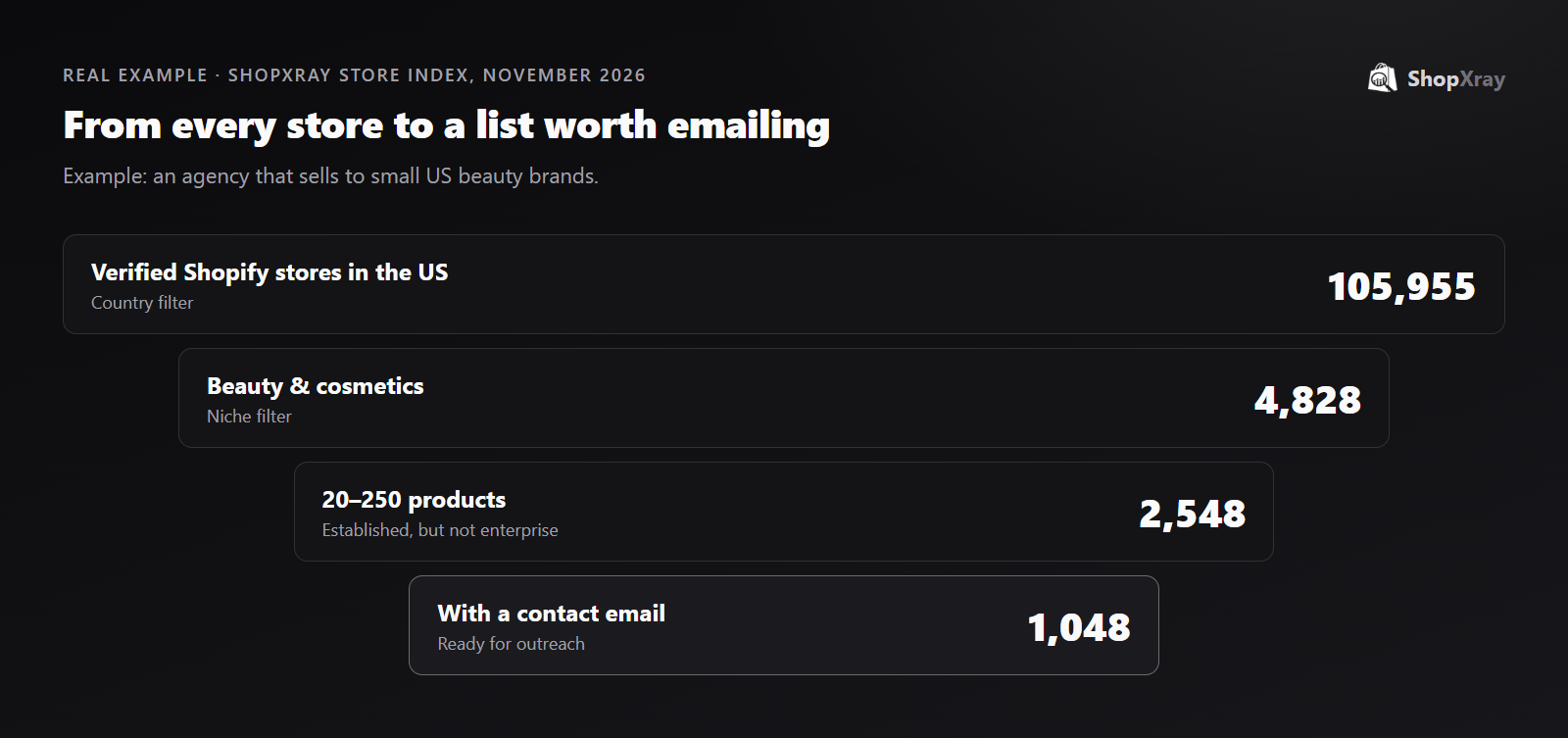
Four filters take you from more than 100,000 US stores to about a thousand that fit and can be contacted. With ShopXray's Shopify store leads you can filter verified stores by country, niche and keyword, see each store's product count and contact email, and export the list to Excel or CSV.
Step 3: Qualify by what the store is missing
Niche and size tell you who could buy. The store's setup tells you who needs you now:
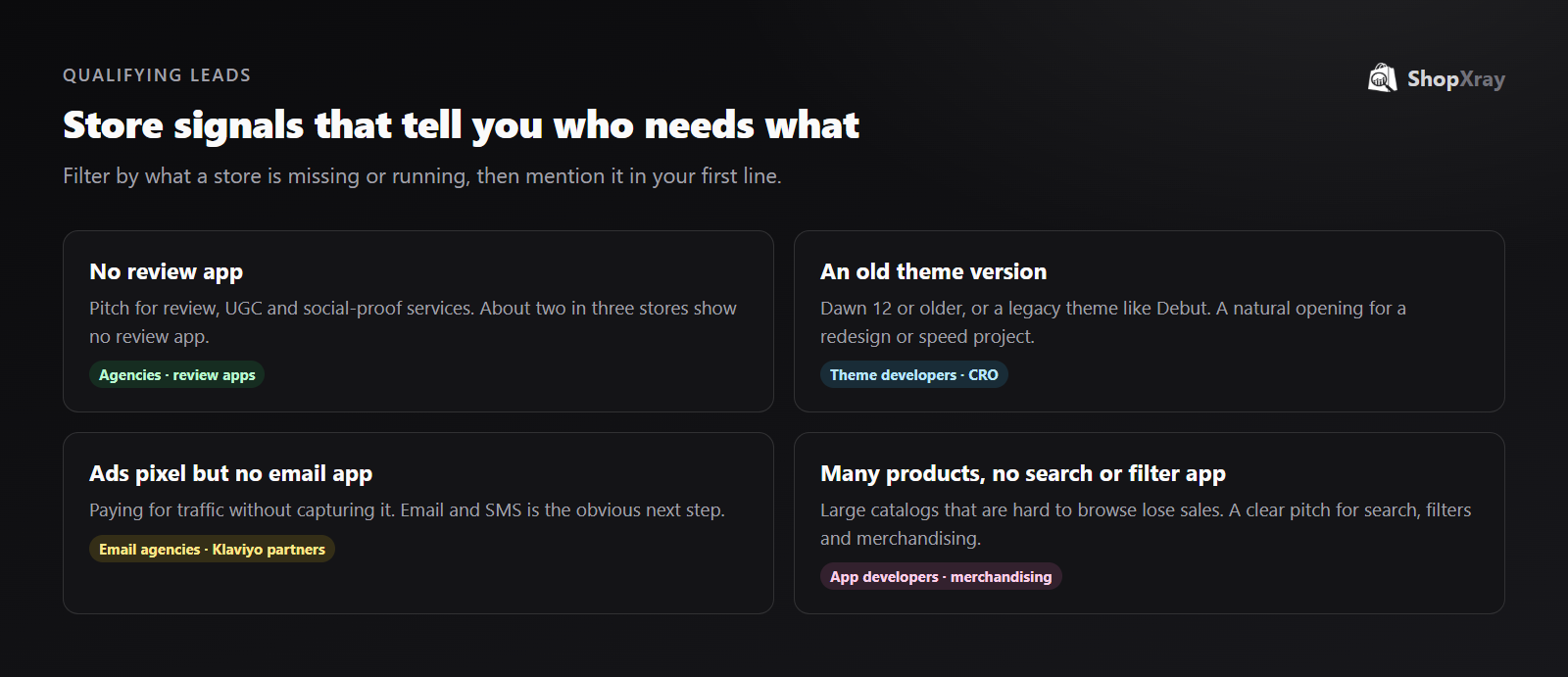
- No review app. About two in three Shopify stores show no review app on their storefront, according to our State of Shopify 2027 data.
- An old theme. Stores on Dawn 12 or older, or legacy themes like Debut, are good candidates for redesign and speed work.
- Ads pixel but no email tool. They pay for traffic but don't capture it.
- Large catalog without search or filtering. Hard-to-browse stores lose sales.
To check a store's theme and apps by hand, see our guides. A store analyzer shows both at once.
Step 4: Find the right contact
For small Shopify brands, the founder or owner usually reads the store's main inbox. Good sources:
- The store's own pages. Contact, About and footer pages, plus the privacy policy, which often lists a business email.
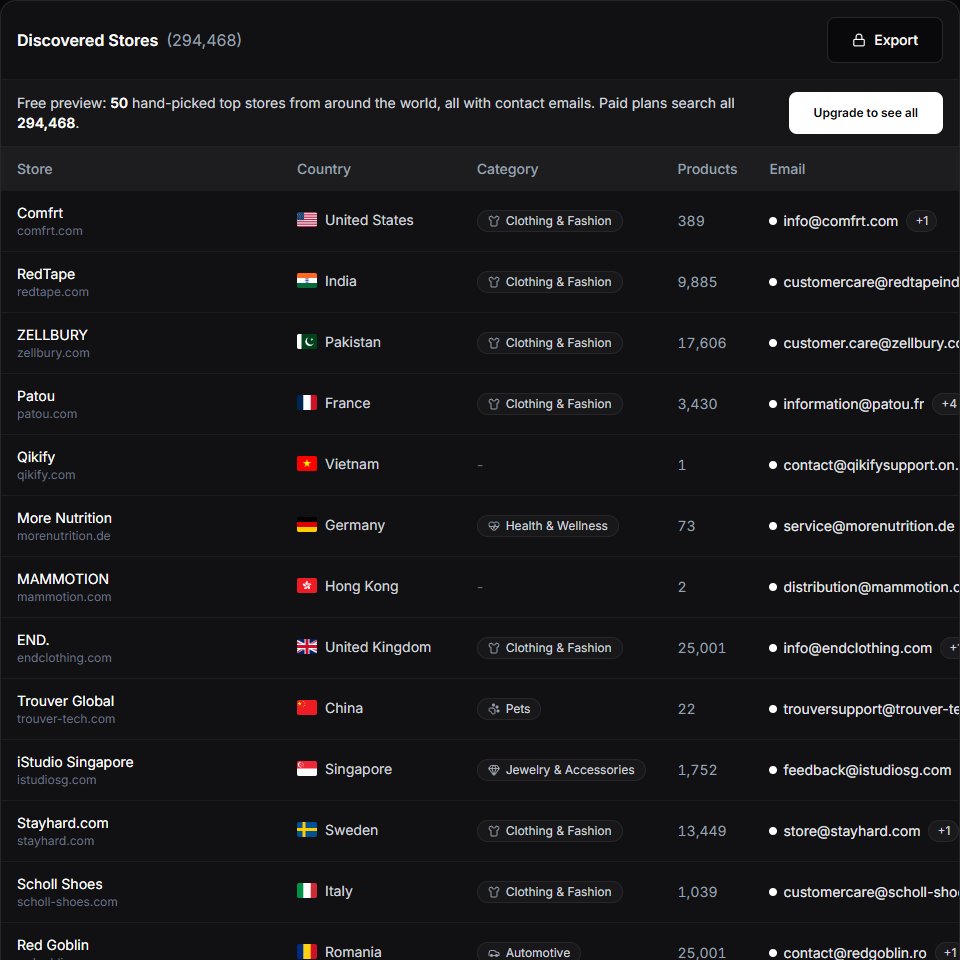
- A store index with contact data. In our index, about one in three verified stores (32.9%) has a contact email on record, each rated by how confident we are that it's real and current.
- LinkedIn, for larger brands with a team, to find the person responsible for marketing or ecommerce.
Use the store's published business addresses. Avoid scraping personal social profiles or guessing personal emails.
Step 5: Write outreach that gets replies
The data you used to build the list is also your best opening line.
- Lead with something specific about their store. "Your best sellers are all in the $40–60 range, but your bundles start at $120" beats "I help Shopify brands grow."
- Make one small, clear offer. A free audit of one thing, a short video, a quick idea. Not a full proposal.
- Keep it short. Four or five sentences. Founders read on their phones.
- Follow up once or twice, with something new each time, then stop.
Step 6: Stay compliant
Cold B2B email is legal in many places, with conditions. This isn't legal advice, but the main rules are:
- United States (CAN-SPAM). Use accurate sender details and honest subject lines, include your physical postal address, and offer an opt-out you honor within 10 business days.
- Canada (CASL). Stricter: you generally need consent, though it can be implied when a business publishes its email address and your message relates to its business.
- EU and UK (GDPR and e-privacy rules). B2B outreach can rely on legitimate interest in many cases, but rules vary by country, and some, such as Germany, generally expect prior consent. Keep messages relevant to the business, collect only business contact data, and make opting out easy.
When in doubt, check the rules for the country you're emailing and keep records of where each contact came from.
If you're building lists to research competitors rather than to sell to them, start with our Shopify competitor analysis framework.
Frequently asked questions
How do I get a list of Shopify stores?
Collect them manually with Google search operators, ad libraries and App Store reviews, or filter a Shopify store index by country, niche and size and export the results.
How do I find the email address of a Shopify store owner?
Check the store's contact, about and privacy policy pages, which often list a business email. Store indexes like ShopXray also collect published contact emails; about one in three verified stores in ShopXray's index has one on record.
Is it legal to cold email Shopify stores?
B2B cold email is legal in many countries with conditions. In the US, CAN-SPAM requires honest headers, a postal address and an opt-out. Canada and some EU countries are stricter and generally require consent. Check the rules for each country you email.
What's a good size of Shopify store to target?
It depends on your offer, but stores with roughly 20–250 products are often established enough to pay for services while still small enough that the founder reads the main inbox.
How can I filter Shopify stores by the apps they use?
Use a store analyzer or lead tool that detects storefront apps. This lets you target stores that don't use your category of app yet, or that use a competitor's.


