How to Find Shopify Stores in Any Niche or Country (7 Methods)

The short answer
Use Google operators like site:myshopify.com "your niche" or inurl:/collections/ "your niche", follow advertisers in the Meta Ad Library, and read Shopify App Store reviews, which show store names. For complete lists, filter a store index by country and niche. Our index holds 500,000+ verified Shopify stores in 196 countries.
Whether you're researching competitors, looking for product ideas or building a list of prospects, it starts with the same question: which Shopify stores exist in this niche? Shopify doesn't publish a directory, but stores leave plenty of traces. Here are seven ways to find them, from free search tricks to a searchable index, plus how to confirm a site really runs on Shopify.
How many Shopify stores are there, and where are they?
Our index at ShopXray holds more than 500,000 verified, live Shopify stores across 196 countries. The United States accounts for about a third of them, followed by Australia and the United Kingdom.
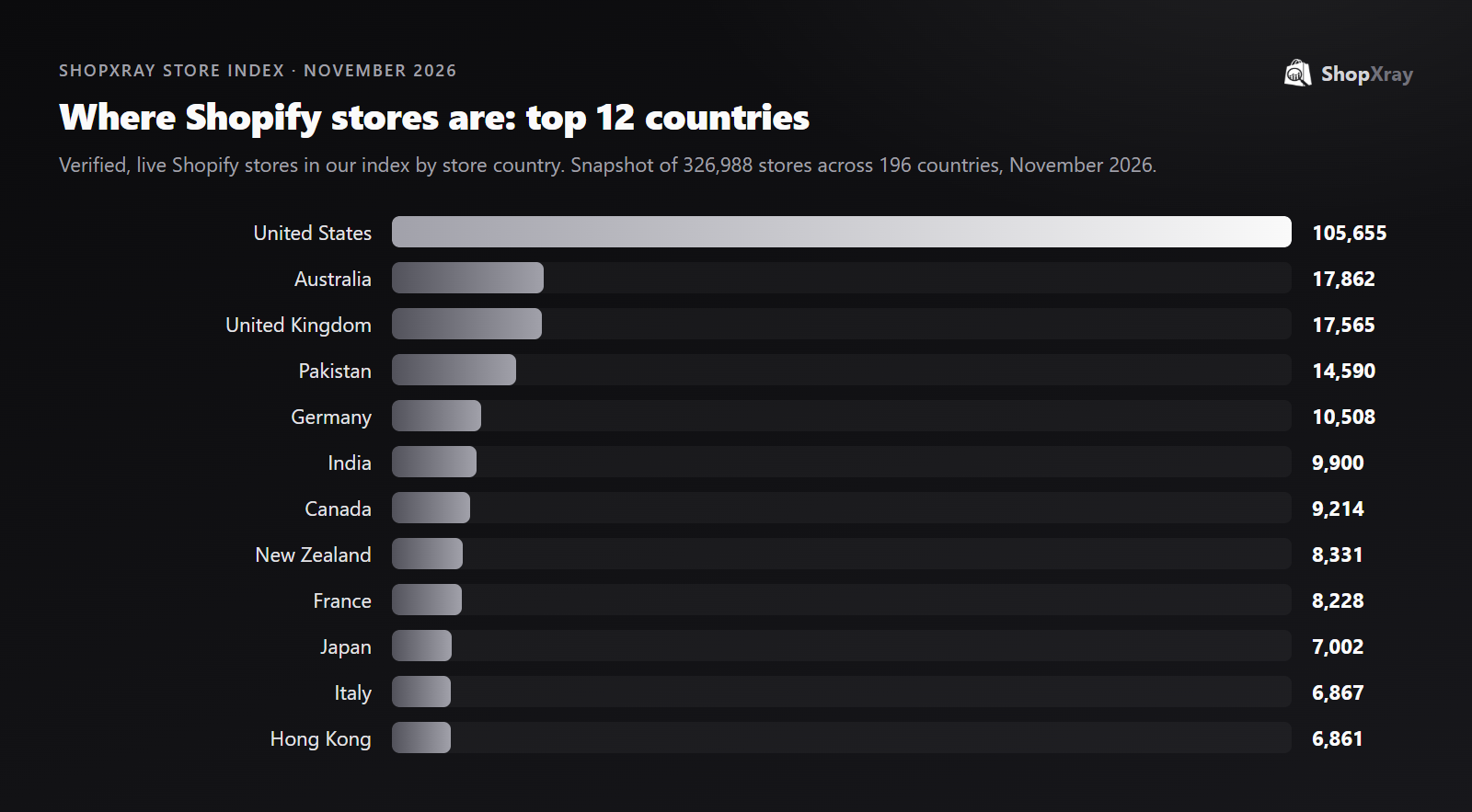
Two things stand out. Australia and New Zealand have far more Shopify stores than their population would suggest, and Pakistan has the fourth-largest count, ahead of Germany and Canada, with fashion, beauty and jewelry stores leading there. If you're targeting a market, don't assume the US is the only one worth researching.
Method 1: Use Google search operators
Search operators are the fastest free way to find stores in a niche. Shopify stores share a URL structure (/collections/ and /products/) and a default domain (myshopify.com), and Google indexes both.
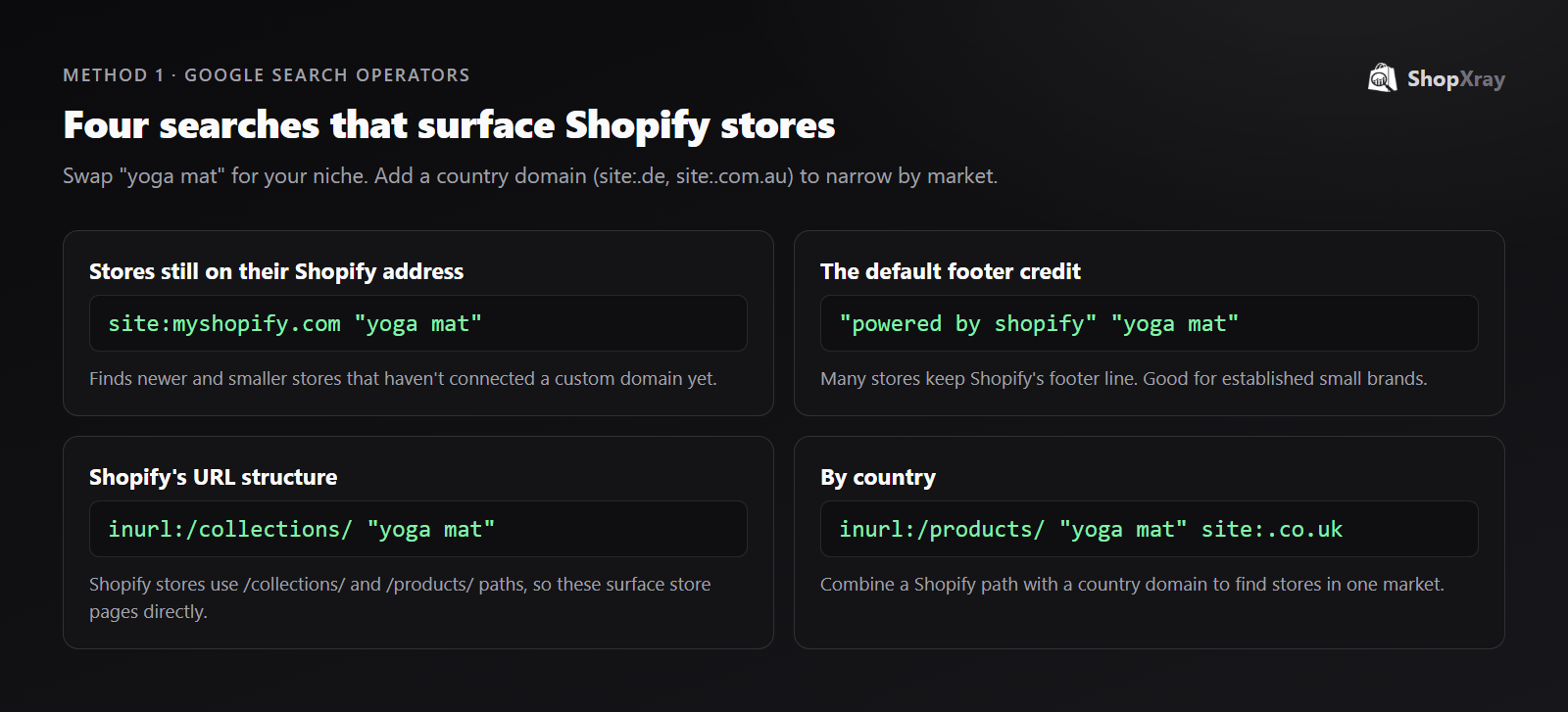
site:myshopify.com "yoga mat"finds stores still using their Shopify address, usually newer or smaller ones."powered by shopify" "yoga mat"finds stores that kept Shopify's footer credit.inurl:/collections/ "yoga mat"surfaces collection pages directly.- Add a country domain such as
site:.co.ukorsite:.com.auto focus on one market.
Google limits how deep you can page through results, so expect dozens of stores per search, not thousands. Vary the keywords (product names, materials, audience) to keep finding new ones.
Method 2: Follow the ads
Brands that advertise are usually the ones worth studying. Search your niche keyword in the Meta Ad Library, set the ad category to "All ads", and open the landing pages. A large share of direct-to-consumer advertisers run on Shopify. Our guide to researching competitors' Facebook and Instagram ads covers what to look for once you're there.
Method 3: Read Shopify App Store reviews
This one is underused. Reviews in the Shopify App Store show the name of the store that left them. Find an app that's popular in your niche (a size-chart app for fashion, a subscription app for coffee), open its reviews, and you have a list of stores that use it, often with their location.
Method 4: Browse the Shop app
Shopify's Shop app lists brands and lets you search by product type. Every brand there runs on Shopify, so it's a clean source, though it leans toward stores that have opted into Shop's marketing.
Method 5: Check social commerce tags
Instagram and TikTok shopping tags often link straight to a Shopify store. Search niche hashtags, open the profiles with shop tabs, and follow the product links. This is a good way to find younger brands before they show up in search results.
Method 6: Look at who competitors link to and partner with
Collaborations, "as seen in" pages, wholesale partner lists and gift guides often name several stores in the same niche. One good store usually leads you to five more.
Method 7: Search a Shopify store index
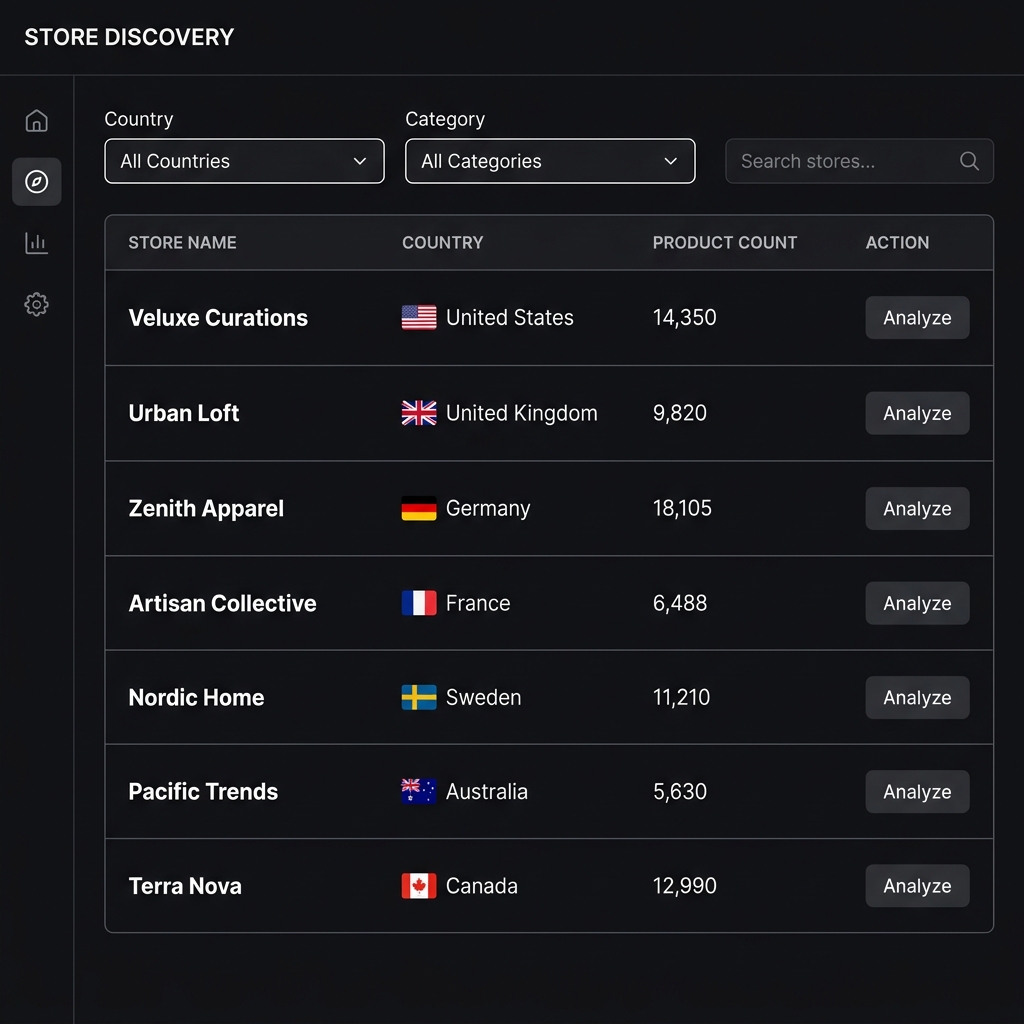
The methods above work, but they're slow and give you a few dozen stores at a time. A store index lets you filter the whole market at once. In ShopXray Discover you can filter verified stores by country, niche and keyword, see each store's product count, and export the list.
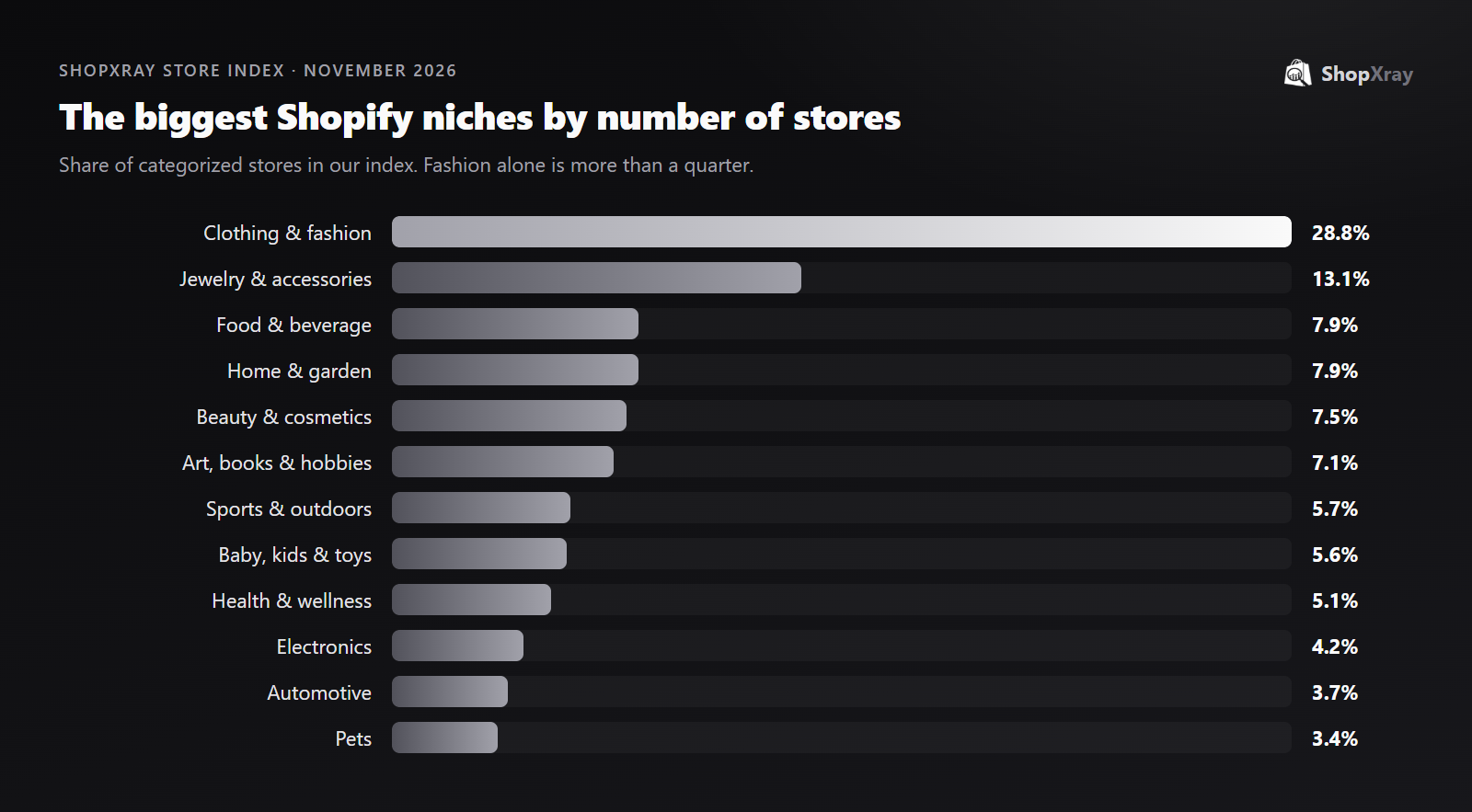
It also shows how crowded each niche is. Here's how the categorized stores in our index break down:
How do you confirm a site runs on Shopify?
Not every store you find will be on Shopify. To check:
- Look for
cdn.shopify.comin the page source. Images and scripts on Shopify stores load from Shopify's CDN. - Search the source for
Shopify.theme. It's present on every store that uses a Shopify theme. Our guide on finding a store's Shopify theme explains how to read it. - Try
/collections/all. Most Shopify stores answer this URL with a product list. - Use a detector. ShopXray's store analyzer confirms the platform and shows the theme, apps and tech stack in one go.
Headless stores (built on Shopify's Hydrogen or another front end) may fail the first three checks while still using Shopify for checkout. A detector is the most reliable way to catch them.
Which method should you use?
| Goal | Best methods |
|---|---|
| A quick look at a niche | Google operators, Shop app |
| Finding competitors that are actually spending | Meta Ad Library |
| Stores using a specific tool | App Store reviews, a store index filtered by app |
| A full list for outreach or market sizing | A store index with country and niche filters |
| Up-and-coming brands | Instagram and TikTok shop tags |
If you're finding stores to sell to rather than to study, read our guide on building a Shopify lead list. It covers filtering, finding contacts and staying compliant.
Frequently asked questions
How many Shopify stores are there?
Estimates vary because many stores are inactive or closed. ShopXray's index holds more than 500,000 verified, live Shopify stores across 196 countries.
How do I find Shopify stores for free?
Use Google search operators such as site:myshopify.com "keyword" and inurl:/collections/ "keyword", browse the Meta Ad Library, read Shopify App Store reviews (they show store names) and follow shop tags on Instagram and TikTok.
How can I find Shopify stores in a specific country?
Add a country domain to your Google search, for example inurl:/products/ "keyword" site:.de, or filter a store index by country. Many stores use .com, so an index catches stores a domain search misses.
Which country has the most Shopify stores?
The United States, with about a third of the stores in ShopXray's index, followed by Australia and the United Kingdom.
How do I know if a website is a Shopify store?
Check the page source for cdn.shopify.com or Shopify.theme, try the /collections/all URL, or run the site through a store analyzer, which also catches headless Shopify stores.


